
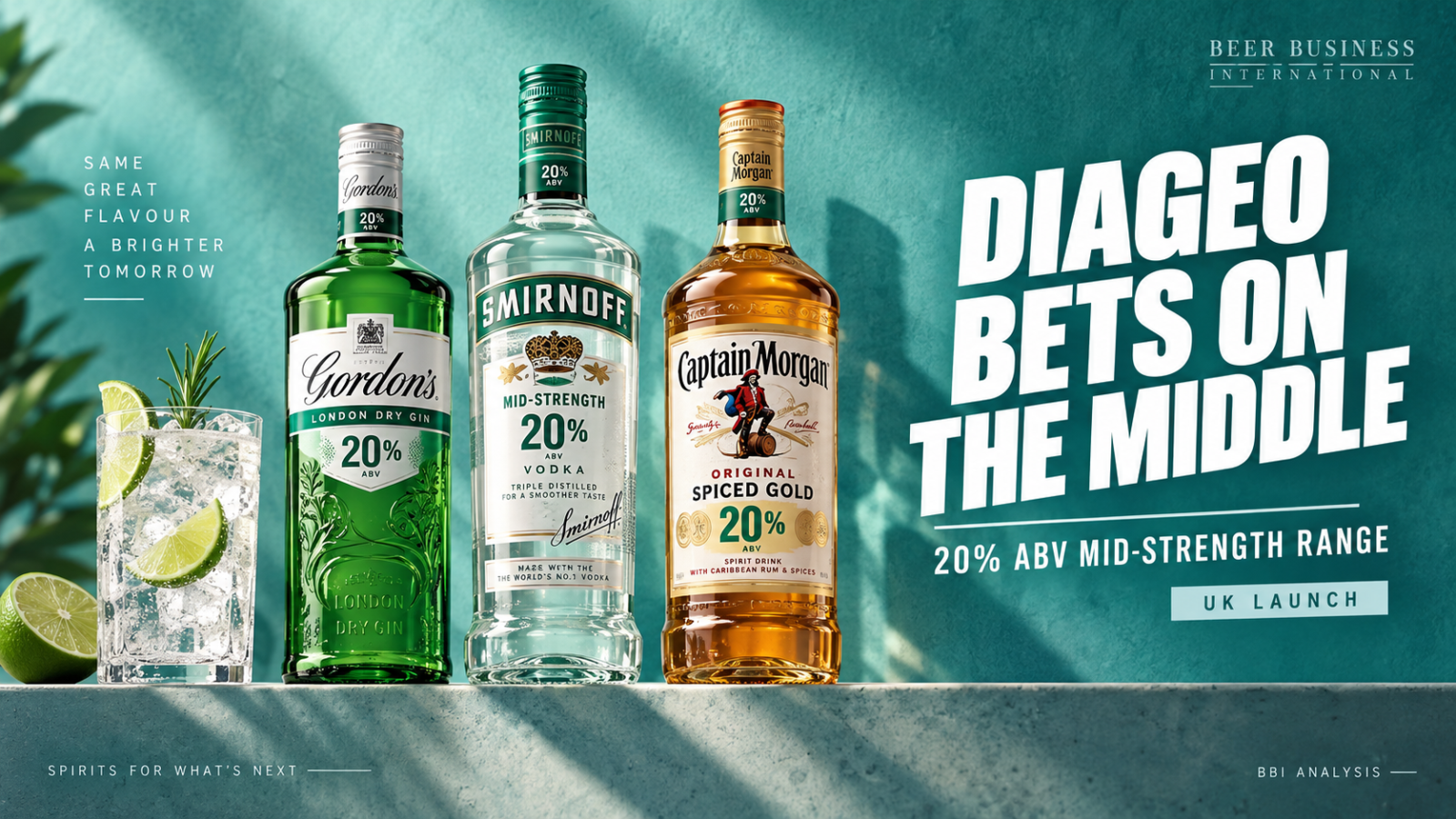
The drinks giant is launching mid-strength versions of three of its biggest spirits brands in the UK, testing whether consumers are ready for a permanent new space between full-strength and alcohol-free.
Diageo is making a significant move into mid-strength spirits with the launch of 20% ABV versions of Gordon’s, Smirnoff and Captain Morgan in the UK.
Rather than creating another alcohol-free extension, the company is targeting the space between zero and traditional full-strength spirits — offering consumers familiar brands and flavours at considerably lower alcohol strengths.
All three products will be sold in 70cl bottles with an RRP of £15, with Diageo positioning them collectively as a new mid-strength range. The UK launch brings three of the company’s best-known brands into the same proposition at the same time, giving the move considerably more weight than a conventional line extension.
Mark Sandys, Diageo’s chief product officer, said consumers increasingly expect brands to provide choices for different drinking occasions, including different alcohol strengths. Diageo says the challenge has been to retain the familiar taste and quality associated with Gordon’s, Captain Morgan and Smirnoff while reducing the alcohol content.
Moderation without leaving the category
The strategy reflects a broader change in how consumers are approaching alcohol.
Moderation increasingly does not mean simply choosing between drinking and not drinking. Consumers may switch between full-strength drinks, 0.0% alternatives, RTDs, smaller formats and lower-strength products depending on the occasion.
Recent Tesco research provides a useful indication of the scale of that behaviour. The retailer says 42% of its customers are looking to moderate their alcohol consumption, and in September launched its Find Your Balance campaign with Drinkaware to make lower and alcohol-free choices more visible.
There is also already evidence of a meaningful mid-strength spirits market. NIQ analysis published in 2025 found that spirits between 20% and 35% ABV represented around 11% of total UK spirits sales. While the segment had experienced modest declines, it was outperforming the wider spirits market and gaining value share.
Diageo appears to believe the opportunity now exists to make that space much easier for mainstream shoppers to understand.
Creating a category consumers can recognise
Perhaps the most interesting element of the launch is not the liquid itself, but the way the products are being presented.
Gordon’s, Captain Morgan and Smirnoff retain their individual brand identities, but each bottle carries a uniform teal treatment intended to identify the products as part of the same mid-strength proposition. Diageo says the consistent colour is designed to give mid-strength spirits a recognisable identity in-store.
That matters.
New drinks categories often struggle because consumers do not immediately understand where a product belongs. A 20% spirit is neither the conventional version shoppers already know nor an alcohol-free alternative.
By giving all three products the same visual cue, Diageo is attempting to teach shoppers what the new proposition means before they necessarily understand the term “mid-strength”.
The initial retail strategy is equally deliberate. The products are being introduced alongside their established parent brands, allowing shoppers to compare the traditional and 20% versions directly, while secondary displays can be used to explain the new proposition.
It is category building at shelf level: strength, colour, positioning and price working together to create something consumers can recognise.
Price could be just as important as health
Moderation is only part of the story.
Affordability is increasingly influencing drinks purchasing decisions, and a £15 price point positions the new 70cl products below many equivalent full-strength spirits at standard shelf pricing.
That gives mid-strength another potential advantage.
Consumers are not simply being asked to purchase a weaker version of an existing product for health reasons. They are being offered a recognisable brand at an accessible price point, while retaining the versatility of a full-size spirits bottle.
That combination could broaden the potential customer beyond committed low-and-no consumers.
A fourth choice rather than a replacement
The most compelling interpretation of Diageo’s move is that it does not require consumers to abandon traditional spirits.
A shopper might choose Smirnoff 0.0 on one occasion, an RTD on another, the original 37.5% vodka when drinking cocktails with friends and the new 20% version when looking for something lighter.
That makes mid-strength a fourth option within the same brand ecosystem, rather than a direct replacement for the original product.
Diageo has already built substantial alcohol-free extensions around brands including Gordon’s and Captain Morgan, while Smirnoff and its wider portfolio have significant exposure to RTDs and different drinking formats. The 20% range fills another space on that strength spectrum.
Will consumers embrace the middle?
The UK will now provide an important test.
There is clear evidence that consumers want greater choice around alcohol strength. The more difficult question is whether they want that choice packaged as a distinct mid-strength spirits category.
Alcohol-free has an immediately understandable proposition. Full-strength spirits are familiar. Twenty per cent sits somewhere between the two and therefore requires more explanation.
Diageo has the brand recognition, retail relationships and marketing power to attempt that education at scale.
If Gordon’s, Smirnoff and Captain Morgan succeed at 20% ABV, other major spirits groups are unlikely to ignore the opportunity for long.
The real significance of the launch may therefore be less about three new bottles and more about whether Diageo can establish another permanent destination in the spirits aisle.
The question for the industry is simple: will mid-strength become a recognised fourth pillar of spirits consumption — or remain an uncomfortable space between two propositions consumers already understand?











Leave a comment