
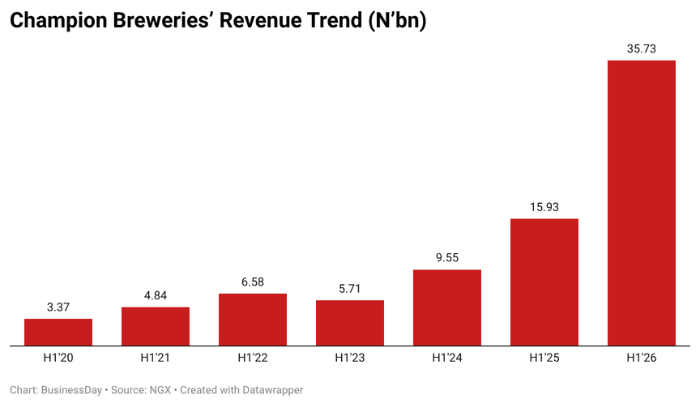
Champion Breweries has emerged as the biggest outlier in Nigeria’s Fast-Moving Consumer Goods (FMCG) sector, more than doubling its revenue in the first half of 2026 as an acquisition-led expansion strategy helped it defy a broad slowdown across the industry.
The brewer recorded a 124.25 percent year-on-year increase in revenue in the first six months of 2026, according to a BusinessDay analysis of the half-year results of 10 major FMCG companies.
Champion was not only the fastest-growing company in the group, but also the only one to record faster revenue growth than in the corresponding period of 2025, when its revenue increased by 66.91 percent.
Its performance stands in sharp contrast to the rest of the sector, where nine of the 10 companies analysed recorded slower revenue growth than a year earlier. BUA Foods and Dangote Sugar Refinery also recorded outright revenue declines.
The divergence signals that Champion’s exceptional growth is less a reflection of a broad recovery in consumer demand and more the result of a deliberate transformation of its business through acquisitions, diversification and expansion into new markets.
Acquisition reshapes Champion’s growth profile
Champion’s growth has been supported by its acquisition of an 80 percent stake in EnjoyBev B.V. and the Bullet brand portfolio, which expanded the company beyond its traditional beer business into Ready-To-Drink (RTD) alcoholic beverages and energy drinks.
The transaction which has also given Champion access to 14 African markets, significantly increasing its addressable market and reducing its dependence on the domestic beer market.
“Champion Breweries’ growth appears to be driven more by its business transformation and diversification strategy than by the broader recovery in beer consumption,” said Kehinde Jones, head of Research and Strategy at Anchoria Investment Group.
According to Jones, the acquisition has expanded Champion’s addressable market, while investments in distribution, brand building and route-to-market capabilities have strengthened the company’s ability to take advantage of the new opportunities.
The brewer’s successful capital raise has also strengthened its balance sheet and provided funding for expansion.
“Champion is currently benefiting from both organic operating growth and inorganic expansion, although higher finance costs remain a constraint on bottom-line growth,” Jones said.
The combination of acquisitions and organic investment has therefore allowed Champion to grow at a time when most of its peers are struggling to maintain the pace of revenue expansion recorded during the high-inflation period.
Read also: CAC flags fragmented ownership data, warns of transparency gaps
Champion stands apart as price-led growth fades
The brewer’s performance comes as Nigeria’s FMCG sector enters a more difficult growth environment.
The combined revenue of the 10 companies analysed was nearly unchanged at N3.28 trillion in the first half of 2026, compared with about the same level a year earlier.
This was despite average inflation falling to 15.51 percent in the first half of 2026 from 23.47 percent in the corresponding period of 2025.
During the period of elevated inflation, FMCG companies were able to generate substantial nominal revenue growth by raising prices to offset higher input costs.
But as inflation moderates, that pricing strategy is becoming harder to sustain.
Consumers continue to face weak purchasing power, resulting in lower volumes, smaller pack sizes, reduced purchase frequency and greater switching to cheaper alternatives.
This has made it increasingly difficult for companies to raise prices without sacrificing volumes.
“High inflation has reduced consumers’ disposable income, leading to lower volumes, smaller pack sizes, reduced purchase frequency and increased switching to cheaper alternatives,” Jones said. “At the same time, companies are facing elevated input costs, FX-related pressures, high financing costs and weaker consumer demand.”
He said the sector is gradually moving from an environment where price increases drive nominal revenue growth to one where companies need to demonstrate genuine volume growth, stronger product mix, pricing power and cost efficiency to sustain earnings growth.
Champion’s performance therefore stands out because its growth is being supported by new products, new markets and acquisitions, rather than relying primarily on price increases in its existing business.
Diversification offers a new growth playbook
Champion’s results highlight how Nigeria’s FMCG companies may need to rethink their growth strategies as the inflationary boost to revenue fades.
The brewer’s expansion into energy drinks and RTD beverages gives it exposure to additional consumer segments, while its entry into 14 African markets provides a potential source of growth beyond Nigeria.
This is particularly significant at a time when the domestic consumer market remains under pressure.
Unilever Nigeria, the second-fastest-growing company in the analysis, recorded revenue growth of 22.24 percent, down sharply from 53.51 percent in the first half of 2025.
Nestlé Nigeria’s revenue increased 11.98 percent, compared with 42.79 percent a year earlier.
Nigerian Breweries recorded 8.88 percent growth, down from 53.85 percent, while International Breweries’ revenue increased by just 0.32 percent, compared with 52.77 percent a year earlier.
Among the major food manufacturers, BUA Foods recorded a 16.15 percent decline in revenue, while Dangote Sugar Refinery’s revenue fell 8.92 percent.
The figures show that Champion is not simply benefiting from an industry-wide improvement. It is outperforming a sector where even some of the country’s largest consumer companies are losing momentum.
What investors should watch
Champion’s rapid revenue expansion makes it one of the most closely watched FMCG growth stories, but the sustainability of that growth will depend on how effectively the company integrates its acquisitions and converts its expanded market reach into recurring organic growth.
Its expansion also comes with higher financing costs, meaning strong revenue growth will need to translate into improved profitability and cash generation for the strategy to deliver lasting shareholder value.
For investors, the bigger lesson is that the next generation of FMCG winners may be determined less by their ability to raise prices and more by their ability to create new revenue pools.
Champion’s acquisition-led strategy offers one example of how companies can escape the constraints of a slowing domestic consumer market by expanding their product categories, distribution capabilities and geographic reach.








Leave a comment